
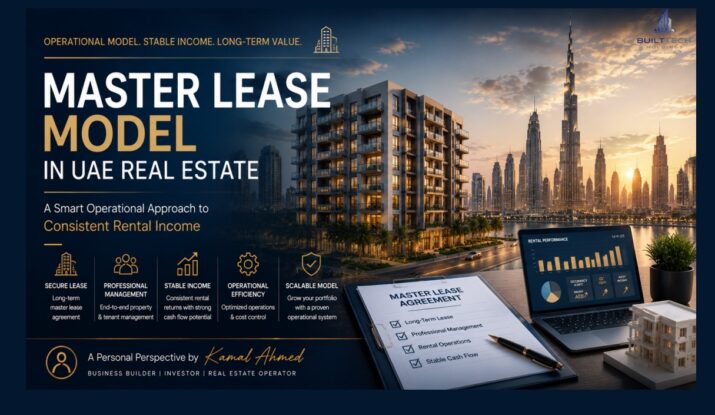
A Personal Perspective on Operational Real Estate Opportunities
written by Kamal Ahmed
Introduction
Over the past few months, while studying and visiting several residential buildings and rental projects in the UAE, I became increasingly interested in one particular operational model that is widely discussed within the real estate industry:
The Master Lease Model.
In my observation, this model is becoming increasingly relevant in markets where rental demand remains active and investors are looking for structured, income-focused opportunities rather than purely speculative investments.
Although the concept itself is not new, the growing demand for professionally managed rental accommodation in the UAE has created an environment where master lease operations can become an interesting business strategy when executed carefully and professionally.
At the same time, this is not a “simple rent-and-profit” model as some people assume. It requires proper financial analysis, operational discipline, legal clarity, and strong management systems.
What Is a Master Lease Model?
In simple terms, a master lease model involves:
- Leasing an entire building or multiple units from a property owner
- Managing and operating those units independently
- Generating income through subleasing or rental operations
Under this structure, the operator does not necessarily own the property but manages the rental business within the agreed lease terms.
In practical terms, the operator’s profitability depends on:
- Occupancy levels
- Rental pricing
- Expense control
- Tenant management
- Operational efficiency
The difference between the lease cost and actual rental income creates the operational profit potential.
Why the Model Is Attractive in the UAE
In my opinion, several factors make the UAE an interesting environment for professionally managed master lease operations.
The UAE continues to benefit from:
- Population growth
- Business activity
- Strong expatriate communities
- Continuous residential demand
- Infrastructure development
This creates ongoing demand for rental accommodation in many residential areas.
At the same time, certain markets within the UAE still offer relatively affordable entry points compared to global metropolitan cities. Areas such as Ajman, for example, may provide opportunities where rental demand and operational management can create sustainable income models if structured properly.
The master lease approach can sometimes allow operators to enter the rental business without the extremely large capital requirements associated with purchasing full properties.
The Business Is Operational, Not Passive
One important realization I have reached during my market study is this:
A master lease model is not passive income.
It is an operational business.
Success depends heavily on:
- Management quality
- Occupancy control
- Tenant handling
- Maintenance coordination
- Financial discipline
Without proper systems, even a good location may struggle operationally.
On the other hand, a well-managed property with stable occupancy and controlled expenses may generate strong recurring cash flow over time.
Occupancy Is One of the Most Important Factors
In rental operations, occupancy stability often has a direct impact on profitability.
A project may appear highly profitable on paper if calculations assume 100% occupancy. However, in reality, vacancies are part of every rental business.
For this reason, experienced operators usually calculate projections conservatively using more realistic occupancy assumptions.
In my observation, sustainable projects are often built around:
- Stable occupancy
- Long-term tenant retention
- Reasonable rental pricing
- Consistent management quality
rather than unrealistic short-term projections.
Financial Discipline Is Critical
Another important lesson I continue to learn is that profitability in master lease operations is strongly influenced by financial control.
Operational expenses can quickly affect returns if not managed carefully.
Typical costs may include:
- Lease payments
- Maintenance
- Cleaning
- Utilities for common areas
- Municipality-related expenses
- Vacancy periods
- Operational staffing
This is why serious operators often focus more on:
- Net profit
- Cash flow stability
- Expense efficiency
rather than only looking at gross rental figures.
Legal Structure Matters
The master lease model also requires proper legal structuring.
In the UAE, lease agreements, subleasing permissions, tenancy regulations, and municipality requirements must all be understood carefully before entering operations.
In my opinion, one of the biggest mistakes new operators can make is relying only on verbal understanding without properly reviewing:
- Lease terms
- Subleasing rights
- Maintenance responsibilities
- Exit clauses
- Legal obligations
Professional legal review and proper documentation are extremely important.
Professional Management Creates Long-Term Value
Another observation I have made is that professionally managed rental operations tend to perform better over time.
Tenants increasingly value:
- Clean and organized buildings
- Responsive management
- Proper maintenance
- Clear communication
- Stable living environments
This directly affects:
- Tenant retention
- Occupancy quality
- Rental consistency
- Long-term reputation
In many cases, operational discipline becomes one of the most important drivers of profitability.
Opportunities and Risks Must Be Balanced
Like any business model, master lease operations involve both opportunities and risks.
Potential advantages may include:
- Recurring rental income
- Scalable operational models
- Lower entry cost compared to full property ownership
- Ability to optimize rental performance
At the same time, risks may include:
- Vacancy periods
- Market fluctuations
- Poor tenant management
- Rising operational costs
- Legal and contractual challenges
For this reason, realistic analysis and disciplined execution are essential.
Final Thoughts
In my opinion, the master lease model represents an interesting operational approach within the UAE real estate sector, particularly in growing residential rental markets.
However, success in this business does not come from speculation alone. It depends on:
- Careful analysis
- Conservative financial planning
- Strong operational systems
- Legal clarity
- Professional management
The UAE real estate market continues to evolve, and operational real estate models may become increasingly relevant for investors and operators seeking sustainable cash flow opportunities.
Ultimately, real estate is not only about owning buildings. Increasingly, it is about managing income, controlling risk, and operating properties efficiently over the long term.
References:
- UAE Government Portal
- Dubai Land Department (DLD)
- General UAE real estate operational practices
- Standard leasing and rental management principles
© Copyright & Disclaimer
All content published on this website, including articles, text, and insights, is the intellectual property of KAMAL AHMED unless otherwise stated.
This material is provided for informational and general business knowledge purposes only. While every effort has been made to ensure accuracy, the author makes no guarantees regarding the completeness or reliability of the information. Readers are advised to conduct their own research or seek professional advice before making any business or investment decisions.
Unauthorized reproduction, distribution, or use of this content without prior written permission is strictly prohibited.
For collaboration, reference, or content usage inquiries, please contact the author directly.