
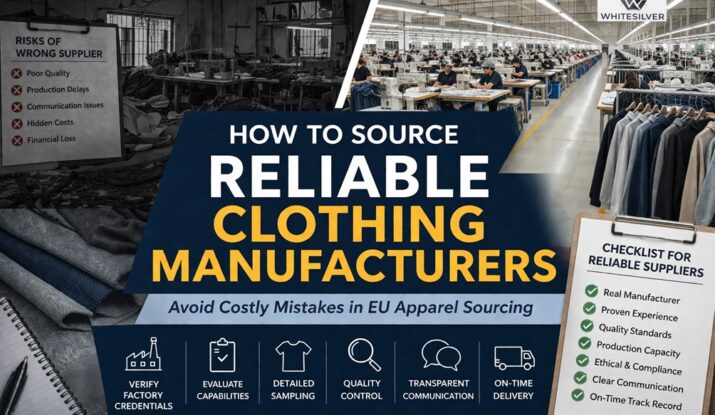
“A practical guide for EU buyers to avoid costly mistakes when selecting garment suppliers.”
Introduction
Sourcing the right clothing manufacturer is one of the most critical decisions for any EU buyer.
On the surface, many factories may look similar:
- Competitive prices
- Good sample photos
- Promises of high quality
But in reality, choosing the wrong supplier can lead to:
- Delayed shipments
- Inconsistent quality
- Financial losses
In this guide, we will explore how to identify reliable garment manufacturers—based on real production experience, not just online listings.
1. Not All “Factories” Are Real Manufacturers

One of the biggest challenges in sourcing is understanding who you are actually dealing with.
Many suppliers present themselves as “manufacturers,” but in reality they may be:
- Trading companies
- Agents
- Small intermediaries
This is not always a problem—but lack of transparency creates risk.
Common Mistake:
Assuming every supplier on B2B platforms owns a factory.
Practical Insight:
In many real cases, production is outsourced to unknown factories, leading to inconsistent quality and poor control.
2. Price Should Never Be Your First Filter

It is natural to compare prices—but focusing only on the lowest price is risky.
Low pricing often indicates:
- Lower fabric quality
- Reduced GSM
- Poor finishing standards
- Lack of quality control
Common Mistake:
Selecting suppliers based only on initial quotation.
Practical Insight:
From real sourcing experience, the cheapest option often becomes the most expensive after production issues, delays, or rejections.
3. Evaluate Factory Capability (Not Just Communication)

A reliable supplier must have the capability to handle your product requirements.
Key areas to evaluate:
- Experience with similar products (hoodies, sweatshirts, jackets)
- Production capacity
- Machinery and setup
- Workforce skill level
Common Mistake:
Judging suppliers based on fast replies instead of actual production capability.
Practical Insight:
Good communication does not guarantee good production. Capability must be verified independently.
4. Sampling Is Your First Real Test

Samples are not just for approval—they are your first quality benchmark.
Use sampling to evaluate:
- Fabric accuracy
- Stitching quality
- Measurement consistency
- Overall finishing
Common Mistake:
Approving samples too quickly without detailed evaluation.
Practical Insight:
In professional sourcing, sampling is treated as a technical validation process, not just a visual check.
5. Quality Control Must Be Planned—Not Assumed

Many buyers assume quality will be maintained once the sample is approved.
In reality, quality must be actively controlled through:
- Inline inspections
- Final inspections
- AQL standards
Common Mistake:
Skipping inspections to save cost.
Practical Insight:
At Whitesilver, quality control is treated as a continuous process across production stages—not just a final checkpoint.
6. Transparency & Communication Are Critical

Reliable suppliers provide clear and regular updates.
This includes:
- Production status
- Potential delays
- Problem reporting
Common Mistake:
Working with suppliers who only communicate when issues arise.
Practical Insight:
In real projects, proactive communication helps solve problems before they become costly.
7. Work With a Structured Sourcing Partner (Strategic Advantage)
Instead of dealing with multiple factories directly, many EU buyers prefer working with a sourcing partner.
A professional sourcing partner:
- Verifies factories
- Manages production
- Controls quality
- Coordinates shipment
Practical Insight:
In many sourcing projects managed by Whitesilver, structured coordination between factory, quality team, and buyer significantly reduces risk and improves consistency.
Final Thoughts
Finding a reliable clothing manufacturer is not about luck—it’s about process, verification, and control.
For EU buyers, successful sourcing depends on:
- Choosing the right partners
- Validating every stage
- Maintaining clear communication
The right approach can turn sourcing into a competitive advantage.
The wrong approach can lead to costly mistakes.
What’s Coming Next
In the next blog, we will explore:
Fabric Selection Guide for Winter Garments (Fleece, GSM, and Quality Explained)
This is one of the most important factors affecting cost, quality, and customer satisfaction.
About Whitesilver
Whitesilver supports EU buyers with sourcing and production management for readymade garments—ensuring quality, consistency, and smooth delivery from concept to shipment.