
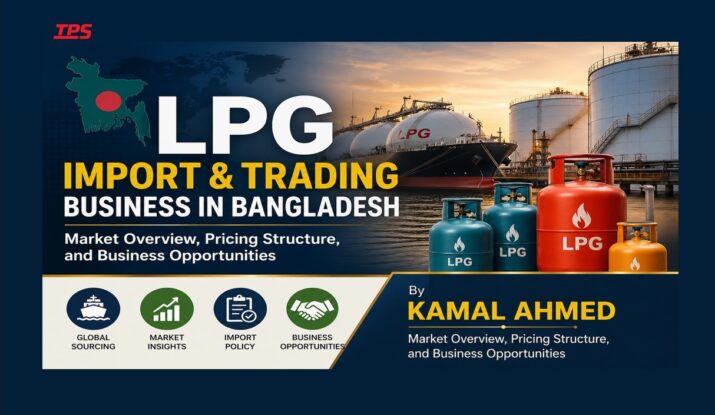
Market Overview, Pricing Structure, and Business Opportunities
by Kamal Ahmed
Introduction
Liquefied Petroleum Gas (LPG) has become a critical energy source in Bangladesh, driven by increasing urbanization, limited natural gas supply, and rising household and industrial demand. Over the past decade, LPG consumption has grown rapidly, positioning Bangladesh as a high-potential import-driven market.
This article provides a practical overview of the LPG trading business, including sourcing, pricing mechanisms, import structure, and opportunities for new market entrants.
Market Overview of Bangladesh
Bangladesh is heavily dependent on LPG imports, with approximately 70–90% of total demand fulfilled through international sourcing. The market is dominated by private sector companies that manage import, storage, bottling, and distribution.
Key Market Characteristics:
- Strong and growing demand across residential and commercial sectors
- Increasing shift from pipeline gas to cylinder LPG
- Competitive private sector participation
- Price sensitivity due to global energy fluctuations
Major LPG companies in Bangladesh include Omera LPG, Bashundhara LPG, Jamuna LPG, and others, who operate large-scale import and distribution networks.
Global Supply Sources
LPG is primarily sourced from major energy-producing regions:
Key Exporting Countries:
- Middle East (Saudi Arabia, UAE, Qatar)
- United States
- Malaysia
Most LPG trade is benchmarked against the Saudi Aramco Contract Price (CP), which is published monthly and serves as the global reference price.
LPG Pricing Structure
Understanding pricing is essential for any LPG trading activity. The import price is typically calculated based on the following components:
- Saudi CP (base price)
- Supplier premium
- Freight (shipping cost)
- Insurance and port charges
Example Price Structure:
- Saudi CP: $750/MT
- Premium: $40–$70/MT
- Freight: $70–$120/MT
Estimated CFR Bangladesh Price: $880 – $960 per MT
Prices are highly volatile and influenced by geopolitical factors, shipping availability, and global oil trends.
Import & Regulatory Framework
LPG import in Bangladesh is regulated and requires compliance with multiple authorities.
Key Requirements:
- Valid import license
- Explosive and safety clearance
- Environmental approval
- Storage and bottling infrastructure
- Banking arrangements (Letter of Credit / Buyer’s Credit)
Recent policy developments have classified LPG as an industrial raw material, allowing extended credit facilities (up to 270 days), which provides financial flexibility to importers.
Business Models in LPG Sector
There are several entry models for businesses:
Full-Scale LPG Operator
- Import, storage, bottling, and distribution
- Requires significant capital investment
Trading / Brokerage Model
- Connect international suppliers with local buyers
- Earn commission per metric ton
- Low capital requirement
Distribution Model
- Purchase LPG locally and supply to retailers or end users
For new entrants, the brokerage model is often the most practical and low-risk approach.
Opportunities in LPG Trading
The LPG market in Bangladesh offers several opportunities:
- Rapidly growing demand
- Import dependency ensures continuous trading activity
- Scope for international sourcing and partnership
- Attractive commission-based income for intermediaries
Challenges and Risk Factors
Despite its potential, LPG trading involves several challenges:
- High price volatility
- Regulatory compliance and licensing complexity
- Large capital requirement for infrastructure
- Risk of unreliable suppliers in international markets
- Dependence on shipping logistics and global supply chain
Careful due diligence and strong business networks are essential for success.
Strategic Recommendation
For traders exploring entry into LPG:
- Begin with a brokerage or sourcing role
- Build relationships with both suppliers and local importers
- Develop strong knowledge of pricing benchmarks (Saudi CP)
- Focus on credibility and long-term partnerships
Identifying Genuine vs Non-Genuine LPG Inquiries
In the international LPG trading market, it is common to encounter a large number of inquiries that may not be commercially viable or genuine. Distinguishing between serious buyers/sellers and non-serious parties is essential to avoid wasted time, reputational risk, and potential fraud.
Key Indicators of Genuine Inquiries:
- Clear Company Identity:
The buyer or seller provides verifiable company details, including registration, office address, and official contact information. - Defined Requirements:
Specific information such as product type (Propane/Butane mix), quantity (MT), delivery terms (FOB/CFR), and destination port is clearly stated. - Banking Readiness:
A genuine buyer is prepared to proceed with formal payment instruments such as Letter of Credit (LC) or approved credit terms. - Consistent Communication:
Professional and timely communication, often through official email domains rather than generic messaging platforms. - Past Transaction Evidence:
Ability to share previous shipment records, references, or trade history.
Warning Signs of Non-Genuine or Risky Inquiries:
- Unrealistic Pricing:
Offers significantly below market benchmarks (e.g., far below Saudi CP-based pricing). - Lack of Documentation:
Inability or refusal to provide company credentials, licenses, or verifiable details. - Overuse of Intermediaries:
Long chains of brokers without direct access to actual buyers or sellers. - Pressure Tactics:
Urgent requests to close deals without proper due diligence or documentation. - Non-Standard Payment Requests:
Requests for advance fees, commissions upfront, or unconventional payment structures.
Practical Recommendation:
For professionals entering the LPG trading sector, it is strongly recommended to:
- Conduct basic due diligence before engaging in negotiations
- Verify counterparties through independent sources
- Avoid sharing sensitive documents without validation
- Prioritize direct and transparent communication
Building a network of verified and trusted partners is key to long-term success in the LPG trading business.
Note:
In commodity trading, credibility and verification are as important as pricing. A disciplined approach to screening inquiries can significantly improve deal success rates and reduce operational risks. - Clear Company Identity:
Conclusion
LPG trading in Bangladesh represents a high-volume, high-potential business sector, supported by strong demand and import dependency. While the industry offers attractive opportunities, it also requires strategic entry, market understanding, and professional execution.
For new entrants, a gradual approach through trading and brokerage can provide valuable experience and sustainable growth in this dynamic energy market.
Author Note:
This article is prepared as a practical overview for business professionals exploring opportunities in the LPG sector, particularly within emerging import-dependent markets like Bangladesh.
Sources & References:
Market insights and pricing structures presented in this article are based on industry benchmarks and publicly available data from leading energy intelligence providers, including Saudi Aramco (Contract Price – CP), Argus Media, S&P Global Commodity Insights (Platts), and global freight indicators such as the Baltic Exchange.
© Copyright & Disclaimer
All content published on this website, including articles, text, and insights, is the intellectual property of KAMAL AHMED unless otherwise stated.
This material is provided for informational and general business knowledge purposes only. While every effort has been made to ensure accuracy, the author makes no guarantees regarding the completeness or reliability of the information. Readers are advised to conduct their own research or seek professional advice before making any business or investment decisions.
Unauthorized reproduction, distribution, or use of this content without prior written permission is strictly prohibited.
For collaboration, reference, or content usage inquiries, please contact the author directly.