
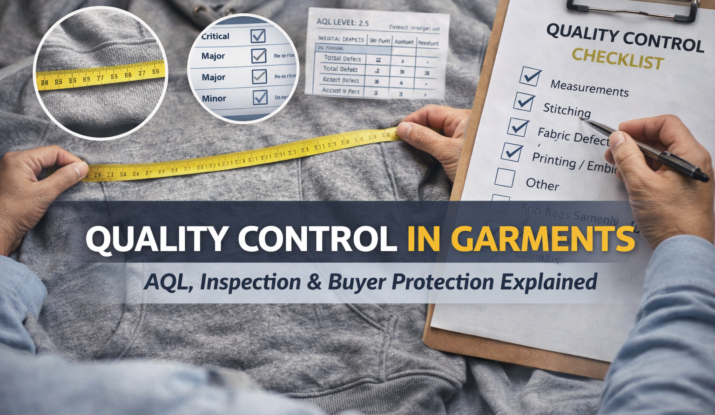
“A practical guide for EU buyers to ensure garment quality and avoid costly production risks.“
Introduction
In garment sourcing, quality is not guaranteed—it must be controlled.
Many EU buyers assume:
If the sample is approved, bulk production will match
But in reality:
- Bulk production involves multiple operators
- Different batches
- Time pressure
Without proper quality control, even good factories can produce inconsistent results.
In this blog, we will explain how quality control works in real garment production—and how buyers can protect themselves.
1. What is Quality Control in Garments?

Quality control (QC) is a structured process to ensure that garments meet defined standards.
It includes:
- Checking materials
- Monitoring production
- Inspecting finished goods
QC is not a single step—it is a system applied throughout production
Practical Insight:
In real projects, consistent quality comes from continuous control—not final checking alone.
2. What is AQL (Acceptable Quality Level)?
AQL is a standard used to determine how many defects are acceptable in a shipment.
It is based on:
- Sampling size
- Defect classification
- Acceptance limits
Types of defects:
- Critical defects → Not acceptable
- Major defects → Limited tolerance
- Minor defects → Small allowance
Practical Insight:
Most EU buyers follow AQL 2.5 / 4.0 standards for garments.
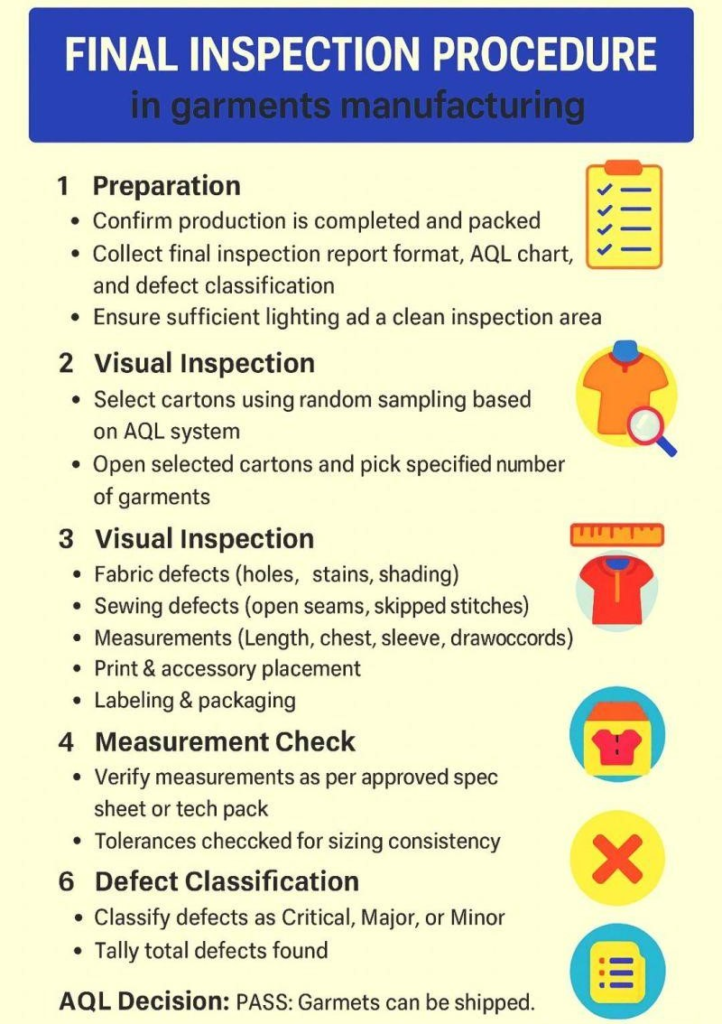
3. Types of Inspections in Garment Production

Quality control is divided into multiple stages:
Pre-Production Inspection
- Before bulk starts
- Checks materials and setup
Inline Inspection
- During production
- Detects issues early
Final Inspection
- Before shipment
- Based on AQL
Common Mistake:
Relying only on final inspection.
Practical Insight:
At Whitesilver, inline inspections are critical to prevent defects from continuing through production.
4. Common Garment Defects (You Must Know)

Some of the most common issues include:
- Stitching defects (open seams, uneven stitches)
- Fabric defects (holes, stains)
- Printing issues (misalignment, fading)
- Measurement variation
Common Mistake:
Ignoring small defects during production.
Practical Insight:
Small defects in bulk can become major problems at retail level.
5. Measurement & Size Control

Accurate sizing is essential for EU markets.
QC checks:
- Chest width
- Body length
- Sleeve length
- Tolerances
Practical Insight:
Even small size variations can lead to customer complaints and returns.
6. Why Quality Control Fails (Real Reasons)

Quality issues usually happen due to:
- Lack of supervision
- Poor communication
- Tight deadlines
- Cost-cutting decisions
Common Mistake:
Assuming factory will manage everything independently.
Practical Insight:
Quality improves when there is structured monitoring and clear communication.
7. How to Protect Your Orders as a Buyer

To reduce risk:
- Define quality standards clearly
- Approve samples carefully
- Use inline inspections
- Conduct final inspection before shipment
Practical Insight:
In many sourcing programs managed by Whitesilver, structured QC systems significantly reduce rejection rates and improve consistency.
Final Thoughts
Quality is not created at the end—it is built throughout the process.
For EU buyers, strong quality control means:
- Fewer returns
- Better customer satisfaction
- Stronger brand reputation
Without QC, even well-produced garments can fail in the market.
What’s Coming Next
In the next blog, we will explore:
Garment Costing Explained: Why Prices Vary in Hoodie & Sweatshirt Production
This will help you understand how pricing is calculated—and how to avoid overpaying.
About Whitesilver
Whitesilver supports EU buyers with sourcing and production management for winter garments—ensuring strict quality control, structured inspections, and reliable delivery across every stage of production.