
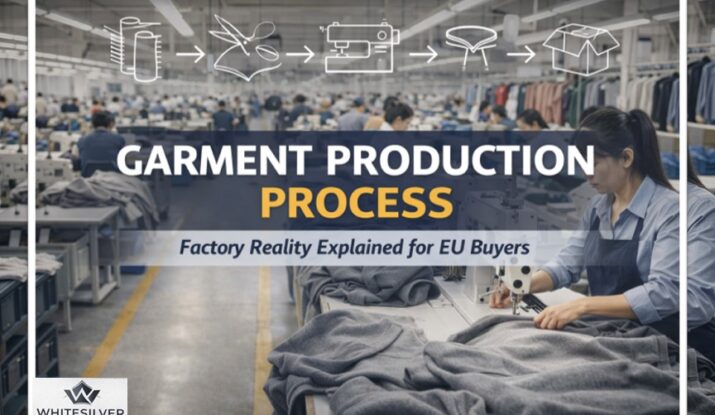
“A practical guide for EU buyers to understand what really happens inside a garment factory.”
Introduction
After fabric is approved, the next stage is production.
For many EU buyers, this is where uncertainty begins:
- Will quality match the sample?
- Will timelines be maintained?
- What actually happens inside the factory?
In reality, garment production is a multi-stage process involving coordination between different teams and departments.
In this blog, we will walk through the actual production workflow inside a factory—step by step.
1. Fabric Receiving & Inspection

Before production begins, fabric is received and inspected.
Key checks include:
- Fabric defects
- GSM verification
- Color consistency
- Shrinkage
Common Mistake:
Skipping proper fabric inspection due to time pressure.
Practical Insight:
In many real cases, production issues originate from fabric problems that were not detected at this stage.
2. Fabric Relaxing & Cutting

Fabric is first relaxed to stabilize before cutting.
Then:
- Fabric is spread in layers
- Patterns are placed (marker)
- Cutting is done manually or by machine
Common Mistake:
Incorrect cutting leads to size variation in final garments.
Practical Insight:
Accurate cutting is critical—any error here affects the entire production.
3. Sewing Line Setup (Production Planning)

Before stitching begins, the production line is organized.
This includes:
- Machine allocation
- Worker assignment
- Line balancing
Each operation (e.g., sleeve attach, rib join) is assigned to specific operators.
Practical Insight:
A well-balanced line improves efficiency and reduces defects.
4. Sewing Process (Core Production Stage)

This is where the garment is assembled.
Key operations:
- Body stitching
- Sleeve attachment
- Rib and cuff joining
- Hood construction
Common Mistake:
Assuming bulk production will automatically match sample quality.
Practical Insight:
Without proper supervision, variations in stitching quality can occur across production batches.
5. Printing / Embroidery (If Required)


If the design includes branding or graphics:
- Screen printing
- Embroidery
- Heat transfer
Common Mistake:
Not verifying print quality during production.
Practical Insight:
Print and embroidery quality must be monitored early to avoid bulk defects.
6. Inline Quality Control (During Production)

Quality control during production is essential.
Inspectors check:
- Stitching quality
- Measurements
- Construction
This helps identify issues early.
Practical Insight:
At Whitesilver, inline inspections are treated as a key control point to prevent defects from continuing through production.
7. Finishing (Final Touches)

After sewing:
- Thread trimming
- Ironing / pressing
- Cleaning
The garment is prepared for final inspection.
8. Final Inspection (Before Shipment)

Before shipment, a final inspection is conducted.
Based on:
- AQL standards
- Random sampling
Common Mistake:
Skipping final inspection to save time.
Practical Insight:
Final inspection is the last opportunity to ensure shipment quality meets buyer expectations.
9. Packing & Shipment Preparation

Once approved:
- Folding & packing
- Labeling
- Carton preparation
- Shipment arrangement
Final Thoughts
Garment production is not just stitching—it is a controlled process with multiple stages.
Each step plays a critical role in:
- Maintaining quality
- Meeting deadlines
- Ensuring consistency
For EU buyers, understanding this process helps:
- Reduce risks
- Improve communication
- Achieve better production outcomes
What’s Coming Next
In the next blog, we will explore:
Quality Control in Garments: AQL, Inspections & Buyer Protection
This is one of the most important systems for ensuring production quality.
About Whitesilver
Whitesilver supports EU buyers with sourcing and production management for winter garments—ensuring structured production control, quality monitoring, and reliable delivery from factory to shipment.