
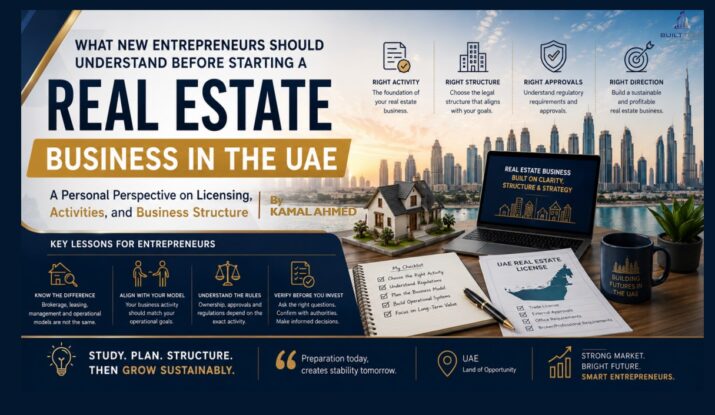
A Personal Perspective on Licensing, Activities, and Business Structure
written by Kamal Ahmed
Introduction
Over the past few months, while studying the UAE real estate sector and exploring the possibility of building a structured real estate business, I encountered an important realization:
Starting a real estate company in the UAE is not only about obtaining a trade license.
It is also about understanding:
- The correct business activity
- The operational model
- Regulatory approvals
- Ownership structure
- Long-term business direction
Initially, I assumed the process would be relatively straightforward. However, after discussions with agents, reviewing activity structures, and analyzing licensing requirements more carefully, I realized that many new entrepreneurs may become confused by the differences between brokerage, leasing, management, and operational real estate activities.
In my opinion, understanding these differences early can save entrepreneurs significant time, money, and future complications.
Real Estate Is a Broad Industry
One of the first lessons I learned is that “real estate business” is actually a very broad category.
At first, many people assume:
Real estate = buying, selling, or brokerage.
However, in practice, the industry includes many different operational models such as:
- Brokerage
- Leasing
- Property management
- Facility management
- Rental operations
- Real estate investment
- Master lease structures
Each model may involve different:
- Business activities
- Authority approvals
- Operational responsibilities
- Legal obligations
This is why choosing the correct activity from the beginning becomes extremely important.
Brokerage and Management Are Not the Same
One of the biggest areas of confusion I encountered was the difference between brokerage activities and operational management activities.
For example, brokerage activities generally focus on:
- Connecting landlords and tenants
- Facilitating transactions
- Earning commissions
In many cases, the broker’s role ends once the agreement is completed.
However, operational real estate models are very different.
In a lease and management structure, the company may:
- Lease properties
- Manage tenants
- Operate rental units
- Handle occupancy
- Coordinate maintenance
- Generate recurring rental income
This becomes an operational business rather than only a transaction-based business.
In my observation, many entrepreneurs initially misunderstand this distinction.
Your Business Model Should Define Your Activity
Another important lesson I learned is that entrepreneurs should first clearly define:
“What kind of real estate business do I actually want to build?”
For example:
- A brokerage company may focus on commissions and transactions
- A property management company may focus on recurring operational income
- An investment company may focus on asset ownership and long-term growth
Without this clarity, entrepreneurs may select activities that do not properly align with their actual business goals.
In my own case, while researching master lease and rental operations, I realized that my interest was becoming more aligned with:
- Property operations
- Rental income models
- Lease and management structures
rather than purely brokerage-based activities.
That realization changed how I viewed the licensing structure entirely.
Foreign Ownership and Local Partner Confusion
Another topic that often creates confusion for new entrepreneurs is ownership structure.
During my discussions with setup agents and while reviewing licensing issues, questions naturally arose regarding:
- 100% foreign ownership
- Local partner requirements
- Mainland vs free zone structures
- Activity-specific approvals
What I gradually realized is that the answer is not always simple or universal.
Different activities may involve:
- Different approval requirements
- Different regulators
- Different operational restrictions
In some cases, the issue may not simply be ownership itself, but rather:
- External approvals
- Regulatory classifications
- Professional licensing conditions
This is why entrepreneurs should avoid making assumptions too quickly and instead verify requirements carefully with the relevant authorities and qualified professionals.
The Importance of Regulatory Awareness
One important realization during my research is that UAE real estate activities are highly structured and regulated.
Depending on the activity, approvals may involve:
- Economic departments
- Land departments
- Real estate authorities
- Municipality-related requirements
- Additional professional approvals
Because of this, selecting an activity without understanding its operational implications can create future complications.
In my opinion, entrepreneurs should spend more time studying:
- What the activity legally covers
- What it does not cover
- Which operational models align with it
before investing heavily into setup and expansion.
Operational Real Estate Requires Systems
Another important lesson I continue to observe is that operational real estate businesses require much more than licensing alone.
Successful operations often depend on:
- Tenant management
- Financial discipline
- Occupancy control
- Maintenance systems
- Legal clarity
- Cash flow management
This is especially important for:
- Rental operations
- Property management
- Master lease models
In many cases, real estate becomes more of an operational business than simply an ownership business.
Entrepreneurs Should Study Before Expanding
One of the most valuable lessons I personally learned from this process is:
It is better to study carefully before expanding aggressively.
Many new entrepreneurs become excited by market opportunities and move quickly into:
- Licensing
- Office setup
- Staffing
- Marketing
without fully understanding:
- Their actual business model
- Regulatory structure
- Operational risks
In my opinion, careful preparation creates stronger long-term foundations.
Real Estate Is Not Only About Selling Properties
Another misconception many people have is that success in real estate only comes from selling high-value properties.
However, the UAE market also includes strong opportunities in:
- Rental operations
- Property management
- Income-focused models
- Occupancy-based business systems
For some entrepreneurs, operational real estate may provide more sustainable and scalable opportunities than purely transaction-driven brokerage businesses.
Final Thoughts
My recent experience studying the UAE real estate setup process helped me realize that building a real estate business requires much more than simply obtaining a trade license.
Entrepreneurs should carefully understand:
- Their actual business objectives
- The difference between activities
- Operational responsibilities
- Regulatory approvals
- Ownership structures
- Long-term business strategy
In my opinion, clarity at the beginning can prevent major confusion later.
The UAE continues to offer strong opportunities in real estate, but successful businesses are often built not only on market excitement — but on structure, discipline, operational understanding, and careful planning.
For new entrepreneurs entering the sector, taking the time to study the industry properly may become one of the most valuable investments they make.
References:
- UAE Government Portal
- Dubai Economy & Tourism
- Dubai Land Department (DLD)
- General observations from UAE real estate licensing and operational practices
© Copyright & Disclaimer
All content published on this website, including articles, text, and insights, is the intellectual property of KAMAL AHMED unless otherwise stated.
This material is provided for informational and general business knowledge purposes only. While every effort has been made to ensure accuracy, the author makes no guarantees regarding the completeness or reliability of the information. Readers are advised to conduct their own research or seek professional advice before making any business or investment decisions.
Unauthorized reproduction, distribution, or use of this content without prior written permission is strictly prohibited.
For collaboration, reference, or content usage inquiries, please contact the author directly.