
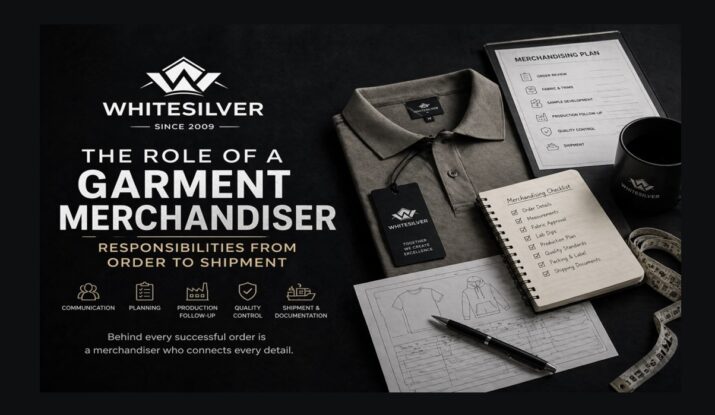
The Role of a Garment Merchandiser: Responsibilities from Order to Shipment
Written by Kamal Ahmed
Introduction: Where One Small Mistake Becomes a Big Problem
Between 1998 and 2000, I worked closely with merchandising and commercial documentation in a garment factory named “Falcon International”, Dhaka, Bangladesh. It was not a long period—around one and a half years—but it was enough to understand something very important:
In garments, even a small mistake can create a big disaster.
A wrong measurement, a missed comment, a delayed fabric, or incorrect documentation—any of these can affect the entire order. Production may run perfectly, but if coordination fails, the shipment fails.
That is when I realized:
The merchandiser is not just a coordinator
The merchandiser is the control point of the whole process
What is a Merchandiser (In Real Terms)?
In textbooks, a merchandiser is often described as someone who manages orders.
But in real factory life:
A merchandiser is the bridge between buyer and factory
A merchandiser is the planner, communicator, and problem-solver
A merchandiser is the person responsible for execution
They translate buyer requirements into factory action—and ensure nothing is missed.
The Real Responsibilities of a Merchandiser
Let’s go step by step, based on real factory workflow:
1. Understanding the Buyer’s Requirement
Everything starts here.
- Tech pack review
- Measurement details
- Fabric and trims
- Quality expectations
- Delivery timeline
If this stage is misunderstood, the entire order will go wrong.
Reality:
Many problems in production actually start from poor understanding at this stage.
2. Sampling Coordination
Before bulk production, samples must be approved.
Merchandiser responsibilities:
- Coordinate with sample room
- Follow buyer comments
- Ensure correct fit and construction
- Manage revisions
A wrong sample = wrong production direction
3. Fabric & Trims Follow-Up
This is one of the most sensitive areas.
- Fabric booking
- Lab dips / color approval
- Accessories (labels, zippers, etc.)
- Delivery timeline
Delay here = production delay
Wrong material = rejection risk
4. Production Planning & Monitoring
Once materials are ready:
- Line planning
- Production schedule
- Daily follow-up with factory
Merchandiser must ensure:
- No bottlenecks
- No delay
- No miscommunication
5. Communication with Buyer
This is continuous.
- Sample updates
- Production updates
- Problem reporting
- Approval follow-ups
Transparency is critical
Reality:
If a problem is hidden, it becomes bigger later.
6. Quality Coordination
Merchandiser works closely with QC team:
- Inline inspection
- Final inspection (AQL)
- Measurement verification
Even small deviations can lead to rejection
7. Shipment & Documentation Follow-Up
This connects with commercial work:
- Packing list
- Invoice
- Shipping documents
- Coordination with forwarder
A mistake here can delay shipment or create financial issues
Daily Challenges a Merchandiser Faces
From my experience, this role is not easy.
A merchandiser must handle:
- Buyer pressure
- Factory limitations
- Time constraints
- Unexpected problems
Example realities:
- Fabric delayed
- Sample rejected
- Production slower than planned
- Last-minute buyer changes
And still, the merchandiser must deliver.
Why Merchandiser is Critical for Buyers
From a buyer’s perspective:
The merchandiser is the main contact person
The merchandiser defines the experience of working with a factory
A strong merchandiser means:
- Clear communication
- Fewer mistakes
- On-time delivery
A weak merchandiser means:
- Confusion
- Delays
- Risk
One Key Lesson I Learned Early
During my early experience, I saw:
A small mistake—sometimes just a missed detail—can create a major issue in production or shipment.
That lesson stayed with me.
It taught me:
- Be careful with details
- Always double-check
- Never assume
Conclusion: More Than a Job Role
Merchandising is not just a job.
It is responsibility
It is coordination
It is execution under pressure
In garments, machines produce—but merchandisers make sure everything works together
Final Thought
From my early days in factory operations, I learned that:
Successful garment production is not only about manufacturing—it is about management.
And at the center of that management is the merchandiser.
A Note to Readers
Thank you for taking the time to read my articles.
Each article on this website is based on real experience, learning, and thoughtful analysis. I share these insights with the intention of adding value to professionals, entrepreneurs, and anyone interested in global business.
All content published on this website, including articles, text, and insights, is the intellectual property of KAMAL AHMED unless otherwise stated.
If you find this content helpful, you are most welcome to share it with others. I kindly request that you do so by linking back to the original article and giving proper credit.
Let’s support and respect original work while growing together through knowledge.
— Kamal Ahmed