
“A practical guide for EU buyers to ensure smooth shipment, compliance, and hassle-free delivery.”
Introduction
After production and quality control, one critical stage remains:
Getting the goods delivered correctly
Many problems in garment sourcing do not happen during production—but during:
- Packing
- Labeling
- Documentation
Even small mistakes at this stage can lead to:
- Customs delays
- Shipment rejection
- Retail compliance issues
In this guide, we will explain how packaging, labeling, and export documentation work in real garment shipments.
1. Garment Packing (More Important Than It Looks)

Packing protects the product and ensures presentation quality.
Common packing methods:
- Individual polybag packing
- Size ratio packing
- Assortment packing
Key considerations:
- Clean folding
- Correct size labeling
- Barcode placement
Common Mistake:
Inconsistent packing leading to confusion at warehouse or retail level.
Practical Insight:
Proper packing reduces handling time and improves customer experience.
2. Carton Packaging & Marking

After individual packing, garments are placed into cartons.
Carton marking includes:
- Buyer name
- Style number
- Size breakdown
- Quantity
- Country of origin
Correct carton marking ensures:
- Easy identification
- Smooth warehouse handling
Common Mistake:
Incorrect or missing carton details causing shipment confusion.
3. Garment Labeling (EU Compliance Requirement)

Labeling is not optional—it is mandatory for EU markets.
Required labels include:
- Fiber composition (e.g., 80% cotton / 20% polyester)
- Care instructions (washing symbols)
- Country of origin
These must follow EU regulations.
Common Mistake:
Incorrect labeling can lead to customs or retail rejection.
Practical Insight:
In many projects, labeling errors are one of the most overlooked risks.
4. Barcode & Retail Requirements
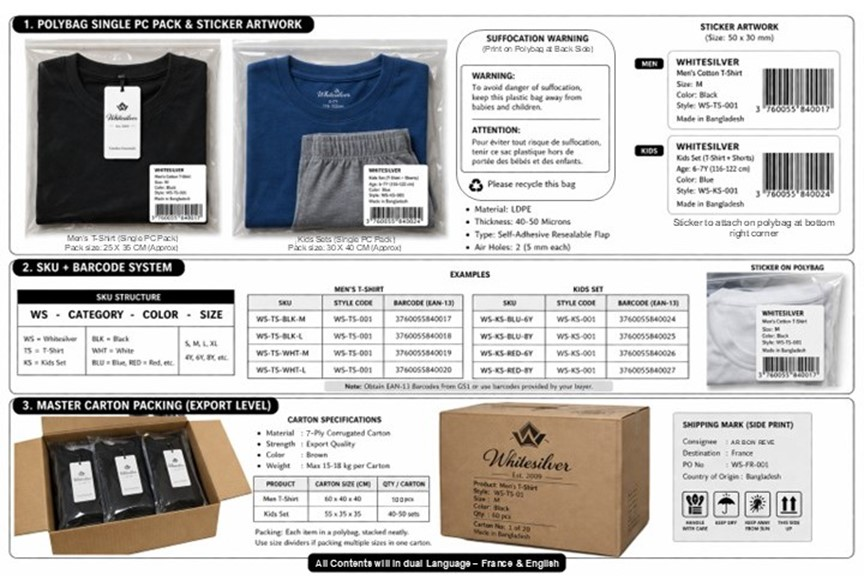
Most EU buyers require:
- EAN barcodes
- Price tags
- Retail-ready packaging
These must match buyer systems exactly.
Common Mistake:
Wrong barcode linking → causes issues at retail checkout.
5. Export Documentation (Critical for Shipment)

For international shipment, proper documents are required:
- Commercial Invoice
- Packing List
- Bill of Lading (B/L)
- Certificate of Origin
These documents ensure:
- Customs clearance
- Payment processing
- Legal compliance
Practical Insight:
Errors in documentation can delay shipments even if production is perfect.
6. Shipping Terms (FOB vs CIF – Basic Understanding)

Two common shipping terms:
FOB (Free on Board)
- Supplier delivers goods to port
- Buyer manages shipping
CIF (Cost, Insurance, Freight)
- Supplier arranges shipping
- Cost includes freight & insurance
Choice depends on buyer preference.
7. Final Pre-Shipment Checklist

Before shipment, always confirm:
- Packing accuracy
- Label correctness
- Carton marking
- Documentation completeness
Practical Insight:
In structured sourcing programs managed by Whitesilver, final shipment checks ensure smooth delivery without last-minute surprises.
Final Thoughts
Production is only successful when goods are delivered correctly.
For EU buyers, proper handling of:
- Packaging
- Labeling
- Documentation
ensures:
- Smooth customs clearance
- Retail readiness
- Professional brand presentation
What’s Coming Next
In the next blog, we will explore:
Top Mistakes EU Buyers Make When Ordering Winter Garments
This will help you avoid common sourcing errors and improve your buying strategy.
About Whitesilver
Whitesilver supports EU buyers with complete export coordination—ensuring correct packaging, labeling, documentation, and smooth shipment from factory to destination.