
Introduction
International commodity trade offers significant opportunities, but it also involves substantial risks. Transactions often span multiple countries, involve high financial exposure, and require coordination between various parties, including suppliers, banks, and logistics providers.
Many failed deals are not the result of market conditions, but rather the lack of proper risk management and due diligence.
At TPS (Trading & Procurement Services), we believe that successful trading is not about taking risks—it is about managing them effectively. This guide provides a practical overview of risk management and due diligence for serious commodity buyers.
Understanding Risk in Commodity Trade
Commodity transactions involve multiple types of risk that must be evaluated carefully:
- Counterparty Risk: The reliability and credibility of the supplier
- Financial Risk: Payment security and banking arrangements
- Operational Risk: Logistics, shipping, and execution capability
- Market Risk: Price fluctuations and timing
- Legal Risk: Contract clarity and enforceability
Understanding these risks is the first step toward managing them.
What is Due Diligence?
Due diligence is the process of verifying all critical aspects of a transaction before committing to it.
It includes:
- Assessing the credibility of the supplier
- Reviewing the transaction structure
- Confirming financial and banking arrangements
- Evaluating contractual terms
Key Insight:
Due diligence is not optional—it is an essential part of professional commodity trading.
Key Risk Areas Buyers Must Evaluate
1. Counterparty Risk
Buyers must verify:
- Company legitimacy
- Business presence
- Transaction history
Working with unverified suppliers significantly increases risk.
2. Financial Risk
Payment methods must be secure and structured.
- SBLC and LC provide higher security
- Informal or unsecured payment methods increase exposure
3. Contract Risk
The SPA (Sales & Purchase Agreement) must clearly define:
- Terms and conditions
- Responsibilities
- Payment and delivery structure
Unclear contracts often lead to disputes.
4. Operational Risk
Buyers should evaluate:
- Supplier’s ability to deliver
- Logistics capability
- Documentation processes
5. Market Risk
Commodity prices fluctuate based on global supply and demand.
Buyers must consider:
- Timing of the transaction
- Market trends
- Price stability
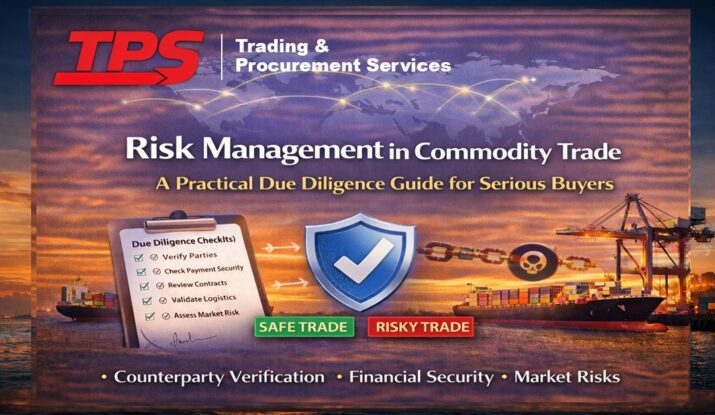
Practical Due Diligence Checklist
Before proceeding with any transaction, buyers should ensure:
- Verification of supplier credentials
- Clear and structured transaction process
- Confirmed banking capability
- Proper understanding of payment instruments
- Alignment of SPA terms with transaction structure
- Defined logistics and delivery plan
- Clarity on intermediary roles (if applicable)
This checklist helps reduce risk and improve decision-making.
Common Risky Behaviors to Avoid
Many risks arise from avoidable mistakes:
- Chasing unrealistically low prices
- Skipping verification steps
- Trusting informal or verbal agreements
- Rushing into transactions without proper preparation
Important Reality:
Most risks in commodity trade are created by poor decisions—not by the market itself.
How Professional Traders Manage Risk
Experienced traders follow structured approaches:
- Use of bank-backed payment instruments
- Clear contractual agreements
- Verified and limited counterparties
- Transparent communication
- Step-by-step transaction execution
Risk is managed through discipline and structure.
TPS Approach to Risk Management
At TPS, we apply strict internal standards to ensure secure and efficient transactions:
- Structured and transparent transaction flow
- Preference for bank-supported payment methods
- Clear documentation and contractual alignment
- Engagement with serious and verified buyers
Our focus is on minimizing risk while ensuring smooth execution.
Key Takeaway
Risk cannot be completely eliminated in commodity trade—but it can be controlled.
Buyers who follow structured processes, conduct proper due diligence, and work with professional partners significantly increase their chances of success.
Conclusion
Commodity trade requires a balance between opportunity and risk management. Buyers who prioritize due diligence, financial security, and structured execution are better positioned to achieve consistent and successful outcomes.
At TPS, we encourage all buyers to approach trade with discipline, clarity, and professionalism.
Next Step
Before proceeding with any transaction, we recommend reviewing our TPS policy on payment instruments and procedures:
Serious buyers are welcome to submit their LOI with full bank details to initiate discussions.