
Introduction
In international commodity trade, price is often the first and most discussed topic between buyers and suppliers. However, many buyers focus only on obtaining the lowest possible price without fully understanding how commodity pricing is actually structured.
This lack of understanding often leads to unrealistic expectations, failed negotiations, and engagement with unreliable suppliers.
In reality, commodity pricing is not arbitrary—it is influenced by global markets, logistics, financial structures, and risk factors.
At TPS (Trading & Procurement Services), we follow a transparent and market-aligned approach to pricing. This guide explains how pricing works in commodity trade and what serious buyers must understand before entering negotiations.
The Foundation: Global Market Benchmark
Most commodities are priced based on international market benchmarks. These benchmarks reflect real-time supply and demand dynamics across global markets.
Key concept:
Price = Market Benchmark ± Adjustments
This means that no serious supplier can offer pricing significantly below global market levels without compromising execution or authenticity.
Key Components of Commodity Pricing
Commodity pricing is built from multiple layers. Understanding these components helps buyers evaluate offers more accurately.
1. Base Market Price
The starting point is the global benchmark or prevailing market rate.
2. Origin & Sourcing Cost
Includes production, procurement, and supplier-side costs.
3. Logistics & Freight
- Ocean freight
- Port handling
- Inland transportation
- Insurance (if applicable)
4. Financial & Banking Costs
- SBLC or LC issuance charges
- Bank confirmation fees
- Transaction-related financial expenses
5. Risk Premium
- Market volatility
- Counterparty risk
- Contract duration
Each of these elements contributes to the final offered price.
CIF vs FOB vs CFR: Why Delivery Terms Matter
Delivery terms significantly impact pricing.
- FOB (Free on Board): Lower price, excludes freight and insurance
- CIF (Cost, Insurance & Freight): Higher price, includes shipping and insurance
- CFR (Cost & Freight): Includes freight but excludes insurance
Important insight:
Two offers cannot be compared unless they are based on the same delivery terms.
Why Prices Differ Between Suppliers
Buyers often receive multiple offers with different pricing levels. This variation is normal and can be explained by:
- Different sourcing origins
- Varying logistics costs
- Different financial structures
- Supplier credibility and execution capability
Key takeaway:
Not all offers are directly comparable unless the full transaction structure is identical.
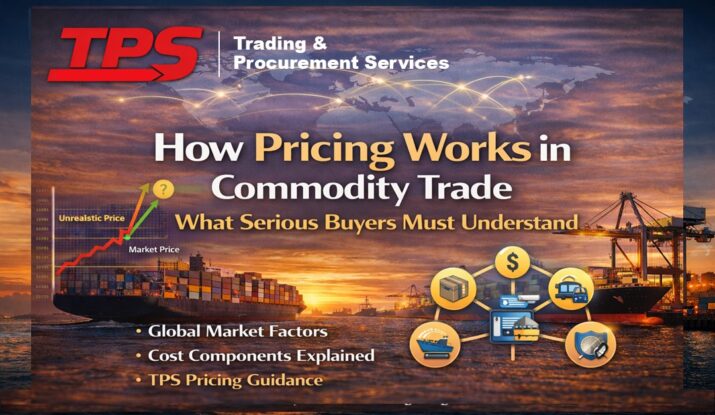
Unrealistic Price Expectations (Critical Insight)
One of the biggest challenges in commodity trade is unrealistic pricing expectations.
Buyers may encounter offers that are significantly below market level. While these may appear attractive, they often carry high risks.
Important reality:
Serious and professional suppliers do not compete through unrealistic pricing—they compete through reliability, structure, and execution.
Offers that are far below market benchmarks are often:
- Non-executable
- Misleading
- Associated with high risk
The Role of Payment Terms in Pricing
Payment structure plays a significant role in determining price.
- SBLC / LC: Higher security, structured pricing
- TT (Telegraphic Transfer): May involve different pricing dynamics depending on risk and relationship
Insight:
Better financial security often results in more stable and realistic pricing.
TPS Practical Approach to Pricing
At TPS, we follow a disciplined and transparent pricing approach:
- Alignment with global market benchmarks
- Clear breakdown of transaction structure
- Consideration of logistics and financial costs
- Focus on executable and reliable deals
We prioritize long-term business relationships over short-term pricing advantages.
Key Takeaway
In commodity trade, the best price is not the lowest—it is the most reliable, structured, and executable.
Buyers who understand pricing fundamentals are better positioned to make informed decisions and build successful partnerships.
Conclusion
Commodity pricing is a structured and multi-layered process influenced by global markets, logistics, financial instruments, and risk considerations.
Understanding these factors allows buyers to evaluate offers realistically and avoid unnecessary risks.
At TPS, we encourage buyers to approach pricing with clarity, professionalism, and a focus on long-term success.
Next Step
Before proceeding with any transaction, we recommend reviewing our TPS policy on payment instruments and trade procedures:
Serious buyers are welcome to submit their LOI with full details to initiate discussion.