
Introduction
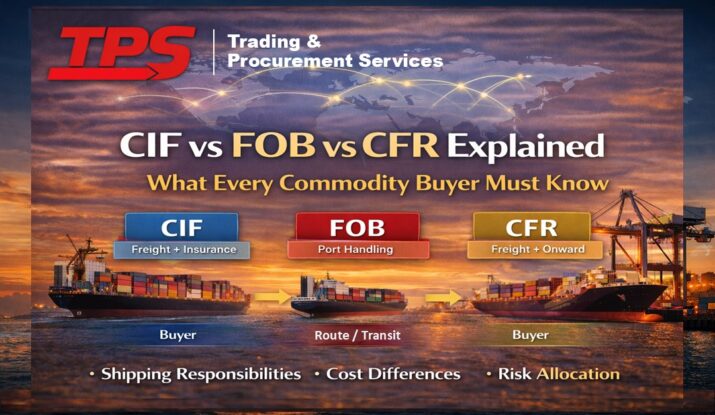
In international commodity trade, one of the most common sources of confusion among buyers is the misunderstanding of Incoterms—particularly CIF, FOB, and CFR.
Many buyers compare prices without realizing that these terms represent completely different cost structures, responsibilities, and risk allocations. As a result, decisions are often made based on incomplete understanding, leading to unexpected costs or operational challenges.
At TPS (Trading & Procurement Services), we believe that understanding Incoterms is essential for evaluating offers correctly and executing transactions professionally. This guide provides a clear and practical explanation of CIF, FOB, and CFR.
What Are Incoterms?
Incoterms (International Commercial Terms) are standardized rules used in global trade to define:
- Who is responsible for transportation
- Who pays for which costs
- When risk transfers from seller to buyer
These terms help avoid misunderstandings and ensure clarity between trading parties.
FOB (Free on Board) – Explained
Definition:
Under FOB terms, the seller is responsible for delivering the goods onto the vessel at the port of shipment. Once the goods are loaded, responsibility and risk transfer to the buyer.
Seller Responsibilities:
- Production or sourcing
- Inland transportation to port
- Export clearance
- Loading onto the vessel
Buyer Responsibilities:
- Ocean freight
- Insurance
- Import clearance
- Delivery at destination
Key Insight:
FOB offers a lower price but requires the buyer to manage logistics and risk after shipment.
CIF (Cost, Insurance & Freight) – Explained
Definition:
Under CIF terms, the seller handles transportation and insurance up to the destination port.
Seller Responsibilities:
- All FOB responsibilities
- Ocean freight
- Insurance coverage
Buyer Responsibilities:
- Import clearance
- Duties and taxes
- Final delivery
Key Insight:
CIF provides convenience for buyers, as the seller manages most of the logistics. The price is higher because it includes freight and insurance.
CFR (Cost & Freight) – Explained
Definition:
CFR is similar to CIF, but the seller does not provide insurance.
Seller Responsibilities:
- All FOB responsibilities
- Ocean freight
Buyer Responsibilities:
- Insurance
- Import clearance
- Final delivery
Key Insight:
CFR is a middle-ground option—buyers benefit from seller-arranged freight but must handle insurance themselves.
Key Comparison
| Term | Seller Covers | Buyer Covers | Risk Transfer Point | Price Level |
|---|---|---|---|---|
| FOB | Up to loading on vessel | Freight onward | At shipment port | Lower |
| CFR | Includes freight | Insurance + onward | At shipment port | Medium |
| CIF | Includes freight + insurance | After arrival | At shipment port | Higher |
Why Buyers Often Get Confused
Many buyers make the mistake of comparing offers without considering Incoterms.
Common issues include:
- Comparing FOB price with CIF price
- Ignoring freight and insurance costs
- Assuming all offers include the same services
Important Insight:
A lower FOB price may ultimately be more expensive than a CIF offer once all additional costs are included.
How Incoterms Affect Pricing
Incoterms directly influence the final price of a commodity:
- FOB excludes shipping costs
- CIF includes freight and insurance
- CFR includes freight but not insurance
This means pricing cannot be evaluated independently of delivery terms.
Understanding this relationship is essential for making accurate comparisons and informed decisions.
Which Option Should You Choose?
The right Incoterm depends on the buyer’s experience, capability, and preference:
- New buyers: CIF is often more suitable due to simplified logistics
- Experienced buyers: FOB provides greater control and potential cost optimization
- Balanced approach: CFR offers a middle option
Choosing the right term depends on your operational capability and risk preference.
TPS Practical Approach
At TPS, we provide clear and structured offers based on agreed Incoterms. Our approach includes:
- Transparent pricing aligned with delivery terms
- Clear breakdown of responsibilities
- Support for buyers in selecting suitable options
We ensure that buyers fully understand the implications of each Incoterm before proceeding.
Key Takeaway
Understanding CIF, FOB, and CFR is essential for:
- Comparing offers correctly
- Managing logistics and costs
- Reducing risk in transactions
Buyers who understand Incoterms make better decisions and achieve smoother trade execution.
Conclusion
Incoterms are not just technical terms—they are fundamental to how international trade operates. Misunderstanding them can lead to incorrect pricing comparisons, unexpected costs, and operational challenges.
At TPS, we encourage buyers to approach commodity trade with clarity, structure, and professional understanding.
Next Step
Before proceeding with any transaction, we recommend reviewing our TPS policy on payment instruments and procedures:
Serious buyers are welcome to submit their LOI with full bank details to initiate discussions.